
COURTESY OF A DEAD MAN: An Excerpt
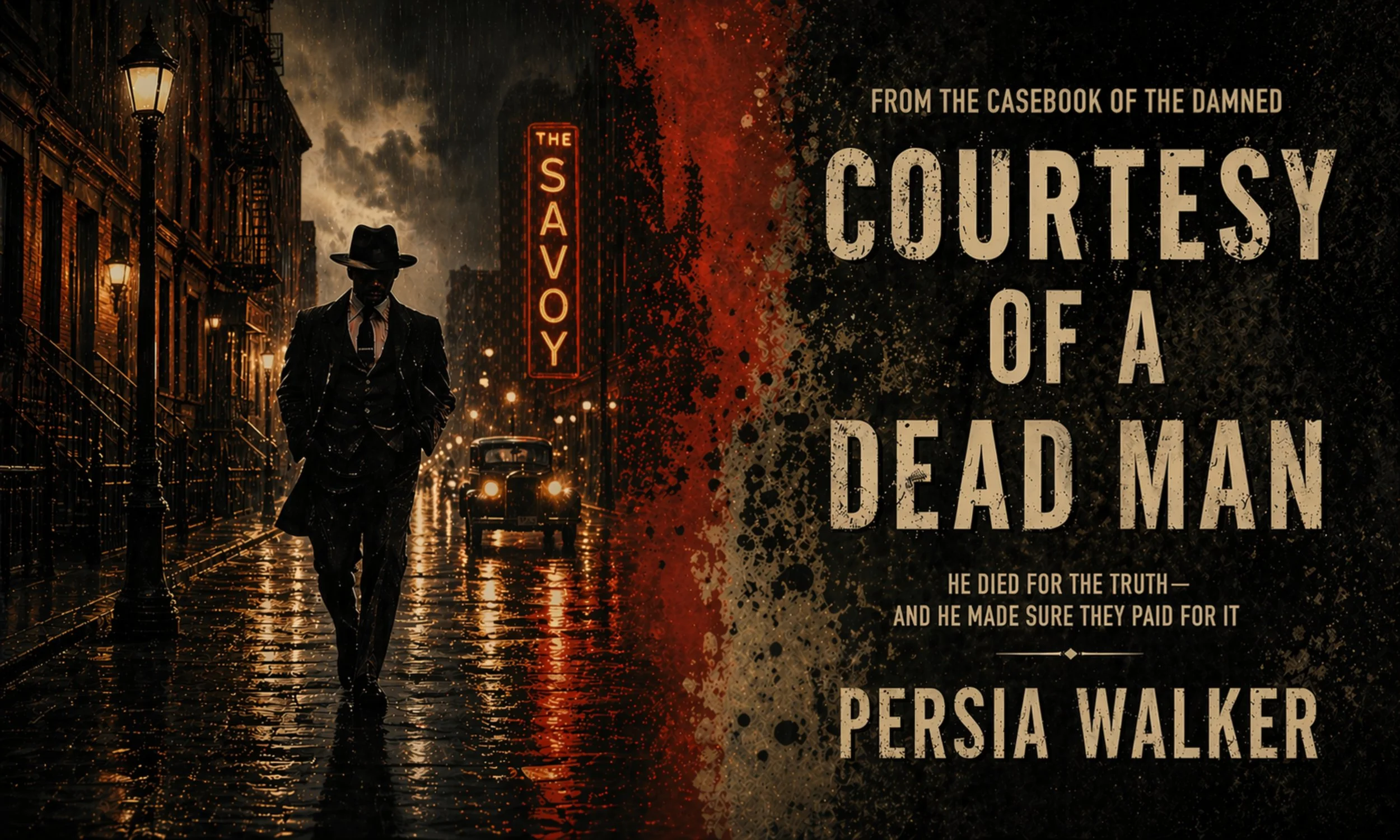
Read an Excerpt
Courtesy of a Dead Man
Part I: Vaughn
Chapter 1
Crosstown wind cut through her coat. Sharp. Bitter. Damp. Gusts that battered the face and chilled the bone. New Yorkers hurried past—collars up, heads down, shoulders hunched against the night. They were all headed home. Toward safety. Warmth.
She was the only one walking the other direction.
She tried to turn back. Tried to follow them. But her legs wouldn't obey. They carried her forward, step after step, deeper into the dark.
Beatrice Vaughn jerked awake, her heart hammering. She straightened up, gave her head a little shake and rubbed her forehead.
That dream—she’d had it again. The details were already slipping away. The dread stayed.
Where was she?
Not at home in D.C. No, she looked around. She was in New York. In her professor’s sublet. At his desk. She blinked. Tried to remember. She was so tired, she’d put her head down for a minute. But she must’ve fallen asleep.
She shivered, drew her sweater around her. Glanced at the dark night-time streets outside the ground-floor window.
New York made her uneasy. She didn’t know why. But lately, she couldn’t shake the feeling that if they stayed too long, the city would collect.
Vaughn was everything she appeared to be—refined, composed, cultured—a woman who belonged in literary salons and university halls. But she hadn’t started out that way. She’d learned to read the streets before she ever read a book. She still knew what it took to survive.
So New York shouldn’t have rattled her.
But it did. It felt wrong.
The clock on the fireplace mantel struck nine. Where was he?
She had served as Professor Victor Grayson’s secretary for twenty-five years, managing his papers, his life. New York was his calling, not hers.
Grayson was a respected philosophy professor at McAllister, the top Negro university in Washington—arguably in the entire country. His work centered on the “New Negro” philosophy, a subject that had long defined his scholarly voice and, in private moments, his purpose.
For now, though, his responsibilities extended beyond the classroom. He was in New York as a guest editor for a special issue of Commonwealth Review dedicated to Harlem’s burgeoning art scene. He was also finalizing a collection of essays based on the special issue, a volume he had titled The New Voice of Harlem. Among the colored literati, his name opened doors for some. Closed them for others.
It hadn’t gotten him home tonight.
They worked at the magazine during the day. Evenings, they worked here. Tonight, she was working alone.
The sublet was small. A bedroom. A living room. A kitchenette no wider than a bookcase. The furniture was spare: twin bed, side table, one worn chair, a desk. In the corner, a phonograph waited with a record half out. Books on philosophy, art, politics and history packed the shelves. The space had a certain charm she couldn’t deny—but it was still the sort of place a man of rank rented out of necessity, not choice.
And it was a far cry from her tidy little place in D.C.
That Tuesday evening, as always, she’d returned to her own smaller, smellier sublet—scrubbed clean and sprayed with rose water—and eaten alone. Then she’d made her way here, to Grayson’s, to finish work that should’ve been done hours earlier. Tomorrow was already waiting.
She’d sorted through marked-up manuscripts and correspondence the way she always did. Calmly. Efficiently. With the confidence of someone who knew his habits, his quirks and the thoughts he never said out loud.
Two hours in, exhaustion had hit her. She set down her pen. Rolled her shoulders. Reached back and pressed her fingers into the tight place between her shoulder blades.
He should’ve been back by now.
He’d gone to one of Ernestine Rose’s literary gatherings at the 135th Street branch of the New York Public Library. Those meetings pulled in everyone—stars, hangers-on, the hopeful and the bored. Stimulating, maybe. For an introvert like Grayson, punishing. He hadn’t wanted to go. She’d told him he should. Now she wished she hadn’t. He’d be no good tomorrow. And he wasn’t here tonight.
She pushed her chair back and went to the window.
Night fell early in New York in late November. The streets had been dark when she arrived. Now, they were darker. Full of shadows. The kind that made women think twice before walking home alone.
She hugged herself. Rubbed her arms. Just the thought of going out there made her tense.
Don’t be ridiculous, she told herself. She’d worked plenty of late nights in D.C.
But there, she’d arranged everything perfectly. Her apartment was close to campus. Close to him.
And D.C. was her city. Her jungle. She knew its predators—their haunts, their tells, their approaches. Cement jungles supposedly all shared the same pulse.
This one didn’t. Not to her.
She massaged her temples. She should leave.
But she couldn’t. Not until she knew he was home safe.
A key turned in the lock. The door creaked open and Grayson stepped inside.
She breathed easier.
He was every inch the gentle scholar. Late fifties. Medium height. Portly. Balding, with a smooth crown and a neat mustache. He projected calm the way others projected power. Soft dignity. Kindness behind the eyes. The quiet that said he’d seen everything and judged very little. Tonight, it didn’t quite hold. He reminded Vaughn of the warmth she used to imagine in someone who would never hurt her—a man who spoke gently because he didn’t have to raise his voice.
Cuddly-looking. That was the term that came to mind. Even Vaughn, with her dry humor, would’ve said so. Maybe it was the deep, warm complexion. More likely the round face and button-brown eyes. Deep down, he recalled the teddy bear she’d never had. The kind of softness a girl pressed her cheek to when the shouting started. Not softness as weakness. As mercy.
That, of course, was something she would’ve denied.
She did, however, openly admire the way he carried himself. The quiet authority that came from years in lecture halls, facing down doubters with nothing but intellect and grace. The mild demeanor that masked a razor-sharp mind. The way he could outthink anyone in the room—and often did, though he never said so.
But tonight, the sharpness in his eyes was dulled. The lines around them were deeper, his movements heavier. He moved like a man who’d been wrestling something heavier than conversation. His overcoat was slung carelessly over one arm. He didn’t just look tired. He looked worn out.
To her, he looked exposed.
And that, she couldn’t stand.
Vaughn rose to her feet. “Long night?”
He set his briefcase down and tossed his coat over the armchair. “Long enough.”
His usually immaculate suit was rumpled. And his favorite bow tie sat crooked beneath a loosened collar.
He made his way to the bookshelves and pulled down a heavy tome. Inside it, a hollowed-out space held a small bottle of Dewar’s White Label and a single crystal glass.
He poured himself a full two fingers and downed half in one swallow.
That was new.
The bottle had been a gift from a friend who’d smuggled it in after a trip to Europe—God only knew how. Grayson treasured it. Usually, he saved it for rare occasions.
Or bad days.
“I’ve reviewed the letters you need to answer,” she said. “The ones that can’t wait. The manuscripts that’ll need final approval if we’re going to make deadline are on your desk.”
He picked up the stack, flipped through the pages without seeing them. “You’re too good to me.”
She’d heard the line so many times before. But tonight, it landed differently—softer, with a hint of regret that startled her.
She watched him closely. “Are you all right?”
He didn’t answer. Just took his drink, moved to the ground-floor window and stared out into the street. His silhouette was still in the amber desk light, shoulders stiff, uneasy. His eyes were sunken, the skin underneath puffy. He hadn’t been sleeping—that much was clear.
Grayson was a philosopher, a scholar—not an editor. His guest role at the Review was temporary, but the pressure of shaping what was meant to be a history-making issue—a compilation of essays, short stories and other thought-provoking pieces by the day’s best Negro talent—was wearing him down.
“You missed Everett Carlisle today.”
He finally turned. “He was there? At the office?”
Grayson and Carlisle. Harlem knew the argument by heart. Polite on the surface. Rotten underneath. Grayson could barely stand the man. Something old lay between them. She would have given anything to know what.
Carlisle wasn’t a professor. He didn’t need to be. Art critic. Theorist. Professional thorn. He even took aim at W.E.B. Du Bois—widely considered the greatest living Negro intellectual in the world.
Du Bois wanted art to do work in the world. Civil rights. Uplift. Leverage. Carlisle wanted art to be free. Free of politics. Free of purpose. Free of Du Bois.
Whether he believed what he preached or just liked being contrary, Vaughn didn’t know. She found him a nuisance.
He was loud about white patronage too. Called it “cultural imperialism.” Accused benefactors—those who Zora Neale Hurston called “Negrotarians”—of manipulating the very art they claimed to support.
Grayson landed in the middle. He didn’t believe the positions were mutually exclusive. “In life, one has to make compromises,” he’d say. “Because one does have to eat.”
Vaughn agreed. Carlisle didn’t. He let it fester. Nursed it into a wedge. The bitterness calcified. Turned ugly. Now he was taking shots at Grayson’s new book. Some people called it honesty. Vaughn called it jealousy.
“You escaped him by a hair,” she said. “He stopped by the office right after you left.”
Grayson rubbed a hand over his face and let out a long breath. The egos and ambitions of Harlem’s intellectual elite were a mess to manage. Herding cats. With claws. They were hungry. Anxious. This was their moment, and no one knew how long it would last. The younger ones told themselves there would be another chance. The older ones—like Carlisle—knew better. The clock was running.
Vaughn picked up one of the manuscripts from the pile on his desk. “Still debating whether to print Carlisle’s essay?”
Grayson shook his head. “There’s nothing to debate.”
Just as she thought. He’d already accepted the Barnes piece—Albert C. Barnes on Negro art and its role in America. She’d read both. Carlisle’s was better. More colorful. More engaging. More direct. More dangerous. (Funny how the same ideas on paper felt more tolerable than when barked across a dinner table.)
But quality wasn’t the issue. And it wasn’t her place to pretend it was. Her professor had made his choice. He had his reasons. She didn’t need to know them. She simply had to support them. The rest be damned.
If Carlisle got wind of Grayson’s choice, the tension would turn vicious. Not just because Barnes was rich, but because he was white—a pharmaceutical magnate who’d made himself an authority on Negro art. To Carlisle, it would be confirmation. Proof that rich white men still dictated the conversation.
She raised an eyebrow. “You need to give him an answer.”
“I know.” Grayson sighed again. “It’s just that … he’ll take it as a rejection of him. Not just his work.”
Vaughn set the manuscript back down. “Isn’t it?”
His gaze cut toward her, sharp and unhappy.
She didn’t push.
Instead, she reached for the appointment book, flipped it open and held it out to him. “Tomorrow. Three interviews in the morning. Meeting with Locke in the afternoon. Then dinner at Margery Davenport’s later this week.”
Grayson barely glanced at the notebook. “Cancel the interviews.”
Vaughn blinked. “You can’t just—”
“Cancel them.”
She stilled. The edge in his voice caught her off guard. He’d never spoken to her like that.
He realized it. “I’m sorry. You’re right. I can’t cancel. Forget I said that.”
She hesitated, deliberating her next words. “Professor, you … you do look tired. Maybe skip the Davenport dinner. Stay home. Rest.” She knew he wouldn’t. But she had to suggest it. He did such a poor job of looking after himself.
He didn’t answer. Just kept staring out the window. Shadows swept over his face with the passing traffic. His silence began to unnerve her.
“Professor Grayson, I—”
“Bea …” He paused, his voice trailing away.
“Yes?”
“Do you think a man should sacrifice everything for the truth?”
The question stopped her cold. She searched his face, trying to read him. Her response was careful. “That depends. Some truths are more dangerous than others.”
He gave a wry, sad smile. “Yes. Yes, indeed, they are.”
He drained the rest of his Scotch and crossed to his desk. Set the glass down. Reached into his inner pocket and pulled out a small crumpled envelope. He hesitated—just for a second—then slid it into the top right-hand drawer and locked it.
A letter? A note? She’d never been one to pry. But this time her gut told her she should.
“Professor, if there’s anything I can do for you, you know you—”
“No, no I’m fine.” He managed another brief smile. “Why don’t you go home? You’ve done more than your share.”
The smile was kind. But it didn’t fool her. Not with that look in his eyes. Not with the way his hand lingered on the drawer.
Vaughn held back a sigh. She’d never seen him like this—so distant, locked in thoughts he wouldn’t share. But she knew she wasn’t going to get any more out of him tonight. So she reached for her coat. “I’ll see you in the morning.”
He didn’t answer right away. Just took off his glasses and pinched the bridge of his nose. Nodded. “Good night, Bea. And once again, thank you.”
She paused in the doorway, turned back. He’d thanked her plenty of times before. He was always gracious. Always thoughtful. One of the reasons she’d turned down every offer—better salaries, better titles, even a proposal—just to stay by his side.
So it wasn’t what he said.
It was the way he said it.
It felt—her stomach clenched—like goodbye.
Continue with Courtesy of a Dead Man on Amazon.
More From the Noir Files


