Q&A with Catherine Tucker, Author of Tall Cotton
A boy fighting for his mother. A lawyer facing his own demons. And a town steeped in deadly secrets.
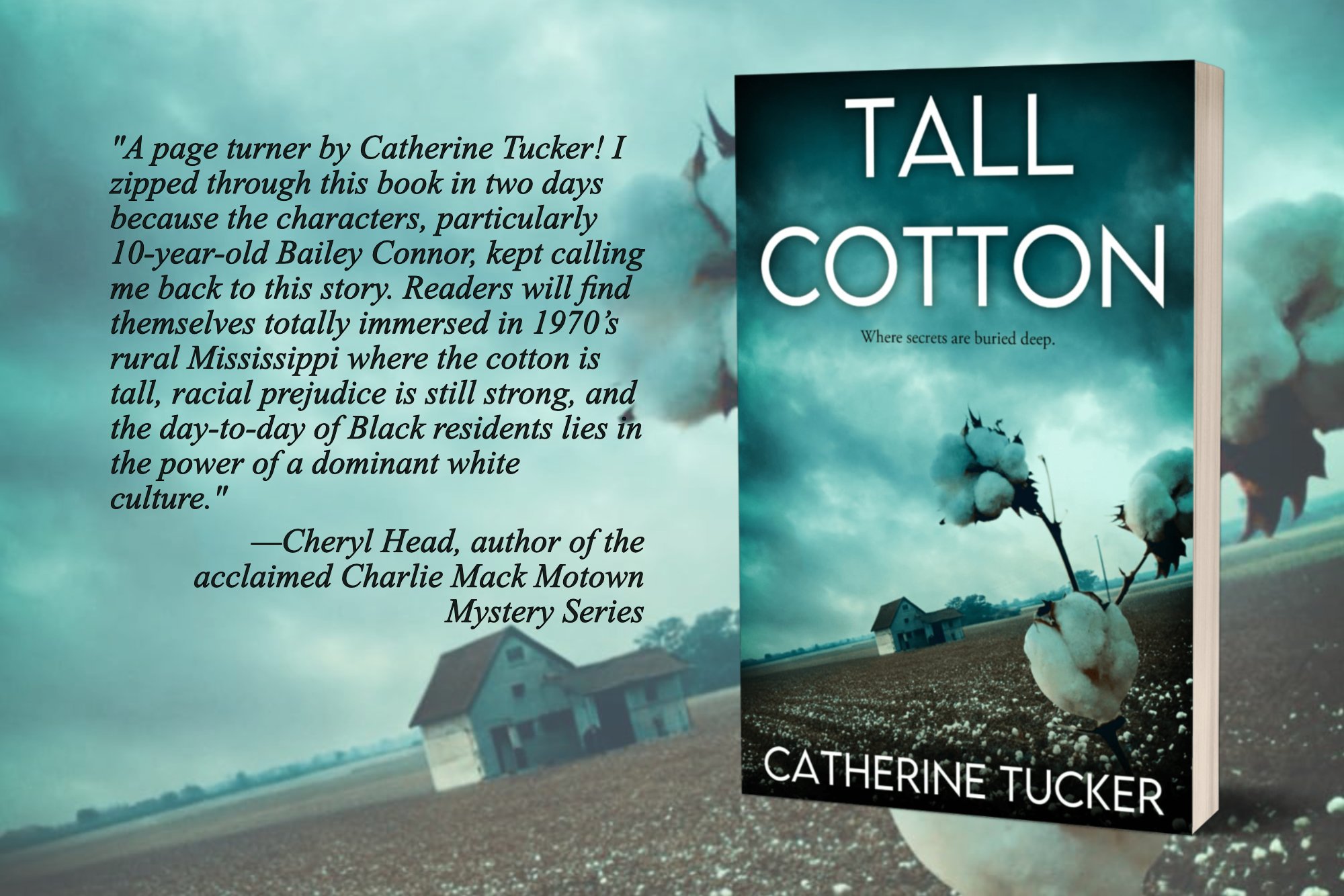

Q&A with Catherine Tucker, author of Tall Cotton.
Catherine was raised in Leland, Mississippi, a Delta town where stories drift as easily as the summer heat. Cotton fields, blues music, and long-held secrets shaped her love of mystery. She read the dictionary for fun, but fiction became her refuge.
Catherine now lives in Houston. When she isn’t writing, she’s reading thrillers, teaching Bible classes, traveling, or enjoying good coffee—and letting the Delta’s echoes follow her onto the page.
Her debut novel, Tall Cotton, brings Washington D.C. attorney Jonathan Streeter back to Mississippi, where he and ten-year-old Bailey Connor are pulled into a murder trial with stakes that reach far beyond the courtroom.
Tall Cotton is a gripping tale of power, truth and consequence in 1970 Mississippi. Our conversation goes deep into what drives a writer to walk that road.
Q: The book would appeal to fans of To Kill a Mockingbird. A coincidence? Intentional?
I’ll be honest — To Kill a Mockingbird was very much on my mind when this story first began to take shape. I’d reread it about six months before the idea for Tall Cotton hit me, and those characters stayed with me long after I closed the book. Scout’s voice in particular — the innocence, the clarity that only a child can bring to a broken world.
So, when I started imagining my own story, I knew I wanted a young narrator who could cut through the noise the way Scout did. That’s how Bailey emerged — not as a copy, but as a child with his own eyes, his own heartbeat, and his own way of telling the truth adults would rather ignore. The themes overlap too: injustice, racial hatred, the way a community can close ranks when truth feels inconvenient. Those echoes are intentional.
But Tall Cotton also has its own DNA — its own setting, its own dangers, and its own way of walking through the South’s long shadow. If readers feel a kinship between the two books, I take that as a compliment. One story inspired me; the other insisted on being told in its own voice.
Q: What drew you to set Tall Cotton in 1970 Mississippi?
A: I wanted to write about a moment when the promises of the Civil Rights era were still colliding with everyday life—when hope and fear shared the same breath.
Q: What is the origin of your story? Where did the idea come from?
It started with a simple call to my sister Mary Ann back in May 2015. We were remembering those early years in Leland — long, flat miles of cotton fields stretching so far they swallowed the horizon. To outsiders it looked peaceful, quiet, nothing much happening. But the older you get, the clearer it becomes: silence doesn’t mean nothing’s going on. It means plenty is happening underneath.
When I hung up, a question hit me hard: What if a murder exploded in a town like that during Jim Crow — and the person killed was someone white, wealthy, and untouchable?
That “what if” opened the whole field.
Q: The title is wonderful. Tall Cotton. So evocative. Tell us what it means, how it came to be.
I’ve always loved the phrase “tall cotton.” I grew up hearing it from the older folks, saying with a smile — “They’re living in tall cotton now,” meaning somebody had made it big, doing well, living high — a little healthy envy wrapped in good humor.
But the phrase carried another meaning for me — a literal one that worked its way straight into the heart of the story. Tall cotton fields were more than scenery; they became a character in their own right. For some characters in the book, those thick, high rows were a shield — a place to slip away or hide when danger closed in. For others, it’s a hiding place where secrets get buried and wrongdoings stay out of sight.
So, the title became a double entendre: the hopeful idiom passed down through generations, and the physical landscape that shaped the lives, choices, and consequences of everyone in this story. It felt Southern. It felt honest. It felt right. And once it landed, I couldn’t imagine calling the book anything else.
Q: Can you tell us about what Tall Cotton is about without spoilers?
In 1970 Lowell, Mississippi, Bailey Connor lives in constant dread from an abusive father. But his world utterly collapses when his mother is arrested for the murder of a powerful white man and the town wastes no time deciding her guilt.
Desperate, Bailey’s family accepts help from Jonathan Streeter, an attorney with a troubled past. Together, they fight for justice during a racially charged murder trial where the truth could be deadly for everyone involved.
Q: Who was your favorite character to write?
Bailey, hands down.
He’s smart in the way only kids can be — no filters, no protective glaze, just truth coming at you straight. He sees everything adults try to hide. Through him I could move between danger and humor without breaking the spell. He gave the story its sharpness, its innocence, its heartbreak.
He’s the one who keeps the reader grounded when the adults start drowning.
Also, talking about race can make people flinch. Bailey’s voice lets me sidestep some of that defensiveness. He’s ten. He’s honest in a way adults aren’t. Through him, people can sit with the truth a little longer, maybe even see it with fresh eyes. Through him, readers can step into the truth without bracing themselves first. He makes room for empathy. He lets people see the cost of injustice without shutting down.
Q: What did you learn from writing this book?
That stories don’t bend just because you ask them to. Characters talk back. They shape the road. I’d already written one full manuscript before Tall Cotton, but this book taught me how much deeper the craft goes. Pacing, yes. Structure, yes. But also listening — learning when a character is trying to tell you who they are instead of who you thought they were.
That’s the part nobody warns you about. They come alive. And once they do, you either follow or you lose the pulse of the story.
Q: You said you came up with the idea for the story in 2015. The book came out in 2025. That’s ten years! What happened? Tell us about the journey.
Those ten years were really two seasons running concurrently. One was a season of preparation for me as a writer — learning the craft from the inside out, figuring out how to tell a story that didn’t just sit on the page but leaped from it. The other was a season of perfection for the book itself: writing, rewriting, tearing things apart, putting them back together again, editing, refining, and then doing it all over.
Along the way, I queried close to seventy literary agents. And with that came a flurry of rejection letters — some kind, some curt, all of them difficult. It was a hard season, no way around it. But it was also a learning season. Every “no” forced me to look at the story with sharper eyes. Every setback pushed me to grow, to polish the work until it was the best version of itself. Looking back, I can see it clearly: the book needed that time to become what it was meant to be.
And so did I.
Q: How has the South changed since the era in which Tall Cotton was written?
Some things shifted. Some things didn’t. Some things changed shape but not substance. There are people pushing forward, people pulling back, and people trying to pretend the past never happened at all. It’s a mixed landscape — progress in one place, backsliding in another. The work continues.
Q: Why did you feel this was a story you needed to tell?
I wanted our young people — all of them — to understand the fight that came before them. Rights weren’t handed over. They were pried loose, piece by piece, by people who risked everything. Forgetting the past is how you lose the lessons baked into it. And lose the rights that people have died for. Second, I wanted to remind people how important it is to never give up hope or the fight. Believe in what you strive for—and strive for what you believe in.
Thank you, Catherine.
Listening to Catherine talk about Bailey, Jonathan, and the world they inhabit reminds you how stories born of real places carry their own kind of gravity. Tall Cotton holds fast to that sense of place. It shows what happens when ordinary people confront fear head-on—and why those stories still matter.
— Walker