Paris 1925: The Christmas Runaway
— From the Archives: A 1920s Article by Lanie Price —
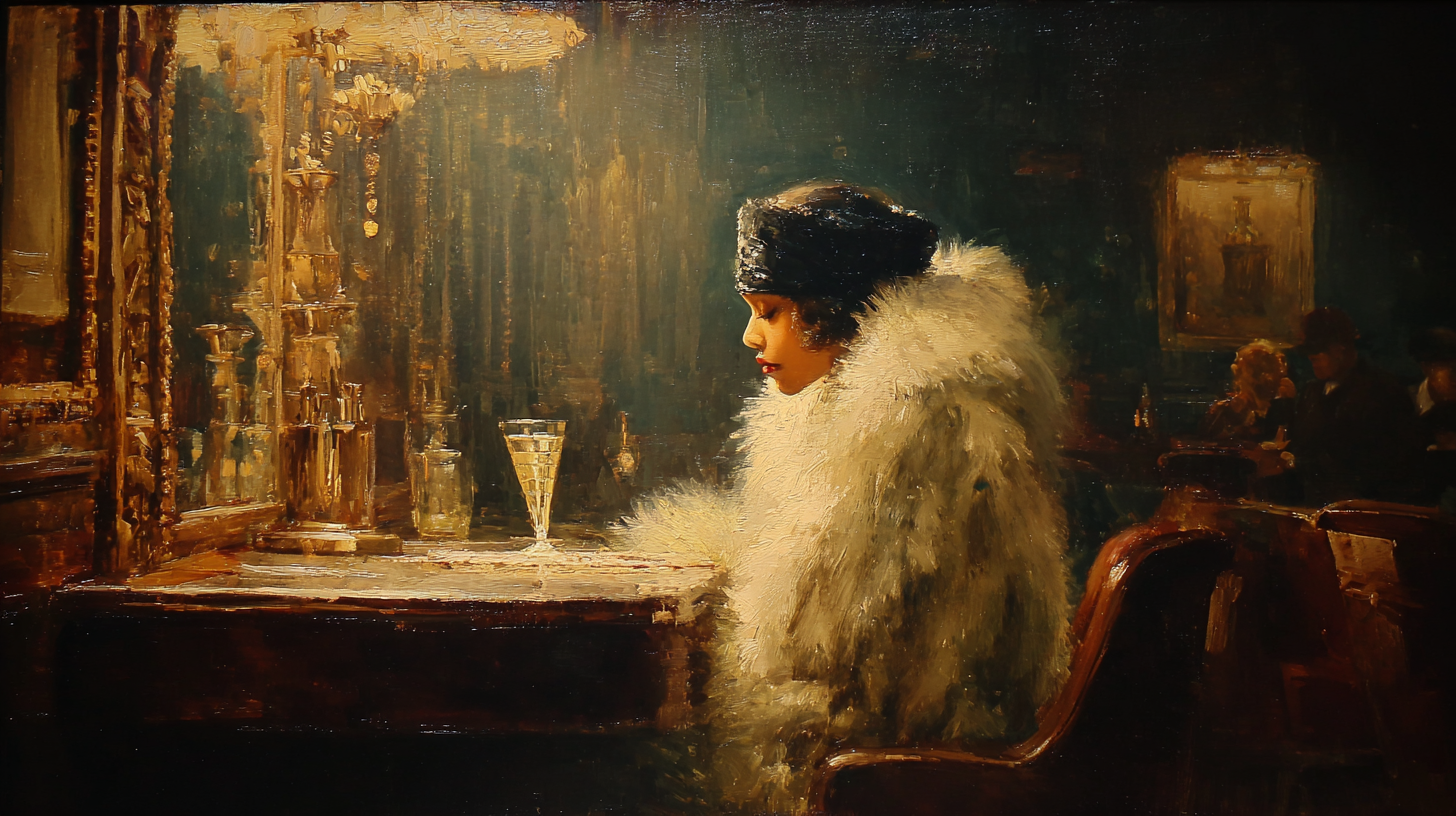
Paris, Christmas 1925: a runaway counting the cost of becoming someone new.
By LANIE PRICE
The Harlem Chronicle
PARIS, Dec 24 — You find them sometimes on Christmas Eve—the ones who've learned that home is the place you can't go back to. I found her staring into the mirror behind the bar at Le Sept d’Or, a little place that stayed open when a lot of others went dark. She wasn't drinking, just sitting there studying her reflection like she was trying to recognize someone she used to know.
It was nearly three in the morning. I'd come in to escape the snow and found her still in her stage dress from the evening show at Le Grand Duc, coat draped over the barstool, a telegram flat on the bar beside an untouched flute of champagne. Her stage makeup had started to crack at the corners of her eyes.
Years ago, we roomed together at Howard University in D.C. Back then, she was known as Annie Mae Johnson, her given name. Now, she wouldn’t answer unless you called her by her new one, Lorelei Denovier. A little overdone, I know. But it showed imagination. It showed stretch.
I was visiting Montmartre, staying with another American newspaper reporter, Marie Hilaire. She’d taken me to a show at Le Grand Duc earlier that night, and there I’d run into Annie Mae—or, as I said, Lorelei. Afterward, Marie had gone home. I’d gone a-wandering through Montmartre, enjoying what I could see in the dark on Christmas Eve. And somehow I’d ended up here.
"That drink for decoration?" I slid onto the next stool.
She looked at me through the mirror—that faraway stare a lot of the runaways in Montmartre get during the holidays. "Can't seem to make it go down."
"Christmas'll do that." I ordered my own champagne. "Especially here."
"My brother found me," she said without preamble. "Jonah. Showed up during my second set tonight. There I was, singing Silent Night, and I see this face in the crowd—face I haven't seen in three years. He didn't recognize me at first. How could he? I've made myself into everything our daddy preached against."
She took a sip, her hand trembling slightly. "Then I saw it dawn on him. Something in how I moved my hands during mama's favorite hymn—I’d jazzed it up beyond recognition, but my hands still moved the way she taught me."
"He come to drag you home?"
"Worse. He came to give me a choice." She slid the telegram across the bar. From a neighbor in Baltimore: Your mother asking for Annie Mae. Says she wants to forgive her before the Lord takes her home. Come quickly.
"Jonah’s been here two weeks looking for me. Staying with some musicians from home who knew me back when. Spent everything he had getting here—sold his watch, borrowed from friends. He's got just enough left for his ticket home. Leaves on the morning boat train."
Classic expat dilemma: choose your dream over your blood—or them over everything you’ve built.
"Are you going?" I asked.
"Don’t know yet. I've got enough for one ticket. But today I got something else, too." She pulled an envelope from her purse. "A contract to join La Revue Nègre’s touring company. Not starring, but featured. It's the break I've been working for. Three years and I finally got it. Starts January second."
"Can't do both."
"No, I can’t. Can I?" She laughed, bitter and short. "If I back out, turn down this offer, I can forget it. They’ll give it to someone else, and I’ll be yesterday’s news." She swallowed. "But that’s not the only thing I’m worried about."
The waiter brought my drink—and a small dish of salted almonds. She took some but sat there holding them. "I miss my family," she said, "but you know what happens when you go home—you mean to stay a week, but mama needs tending. Then the church ladies start talking about proper jobs for proper girls. Then Mr. Lewis needs a wife to raise his children. And suddenly you're back to being Annie Mae Johnson again, singing hymns on Sundays, wondering if Paris ever happened."
"They can’t make you stay if you really want to go. They didn’t the first time."
She smiled at that. "No, I know they can’t make me. But I gotta admit, I’m a little scared I won’t have the drive, the energy I did when I first left." She took another sip. "Like I said, I do miss my family. And sometimes it gets lonely over here. Everything’s work. New people. New language. It’s fun—but it’s exhausting, too." She traced the rim of her glass. "Then there’s the money. It would take just about all I’ve got to buy that ticket. How would I get back? It would take forever to save as much as I need again. And when I got back here—if I made it back—I’d have to start all over. Fight to find a new place to live, a new place to sing—’cause Gene ain’t gonna hold my spot at the Duc, either."
"All right. Suppose you stay? Don’t go home. What then?"
"Mama dies thinking I'm too proud to come home and be forgiven. Jonah goes back alone, tells everyone how I chose sequins over family. And I spend the rest of my days feeling guilty. But I keep being Lorelei, keep being free, keep being..."
"You?"
"Yeah. But then again, who am I? That’s what Jonah asked me today. ‘You my sister,’ he said. ‘My Annie Mae. And she belongs back home with the rest of us. You act like you some orphan, girl—like you ain’t got nobody. But we know that ain’t true.’"
She gave a half-smile, shook her head. "That’s what he said to me. And you know, it was sorta true. Sort of." She drained her glass. "Annie Mae was real. Is real. That girl who sang in the church choir, who helped mama with washing, who knew every family in the neighborhood—she's the one who had the guts and the gumption to get me outta there. But Lorelei is real, too. I built her, sure, but she's who I am now. Maybe who I was always supposed to be. And it sounds crazy, but somehow I feel like I’d be disappointing Annie Mae—the girl I was—if I let Lorelei die, ’cause she’s the woman Annie Mae fought to be."
The snow was falling harder outside, muffling the sounds of the late-night stragglers heading home.
I looked at her, didn’t ask what she’d do. She’d pretty much told me. "It takes a lotta strength to do what you did—to do what you’re about to do. Got any secrets you want to share?"
Another smile. "Thanks for that." She reflected. "It’s not all that complicated. You have to cut those ties clean yourself, before life does it messy for you. You have to be self—"
Just then, the bartender dropped a tray of glasses—the crash splitting the quiet. We both jumped. Annie Mae laughed, short and bitter.
"Jonah's waiting at a café near Gare du Nord." She stood, gathered her coat. "I should go."
She left then, disappearing into the snow. I sat there a while longer, thinking about the tension between freedom and belonging—and how each demands a price.
Marie was still up when I got back, working on a story about the murder of a medium. I filled her in on my conversation with Annie Mae, mentioned how I’d asked her how she managed to survive the choices she faced.
"She said something about what you had to be—what you had to make yourself become. But there was a noise and I didn’t quite catch it."
"Well, try to remember, ’cause it sounds worthwhile." Marie turned back to her typing.
It took me a few minutes of thinking, but I did remember the missing word—a word that was both cruel and necessary, both liberation and loss.
I shared it with Marie and she had one response. "Eh bien. I agree."
Can you figure out the word—the key to Annie Mae’s hard-won wisdom?
Copyright © 2025 Persia Walker. All rights reserved.