Walking Paris Back to Life — and Lyon Into the Future
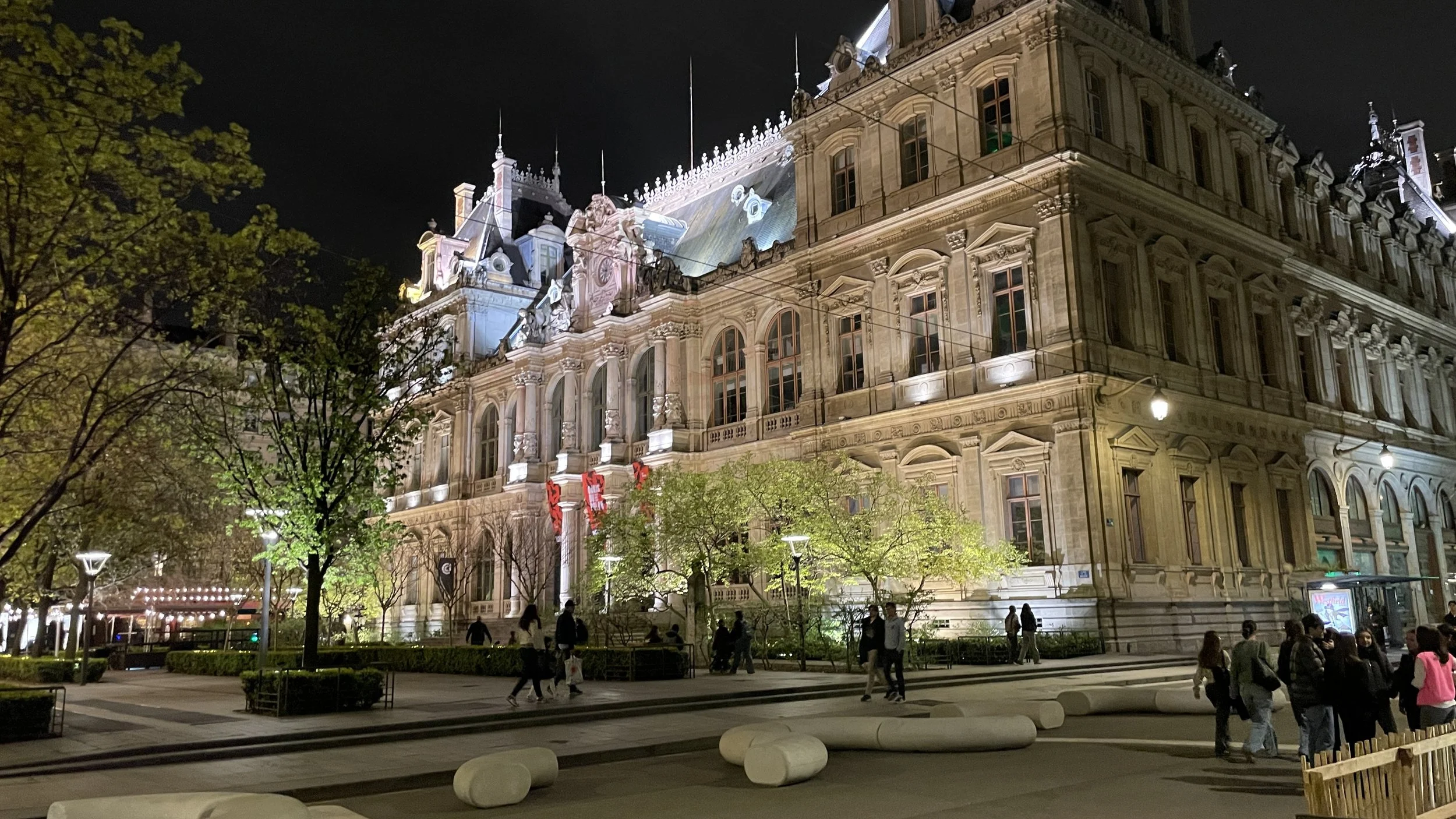
Palais de la Bourse, main venue for Quais du Polar, in Lyon, France, April 3-5, 2026 © Persia Walker
I went to Paris looking for the past and came back with something I hadn't expected to find — myself. First, let me tell you who sent me there to begin with: my David. That’s David McKay. A New York attorney, he first appeared in Lyrics of a Blackbird. Now, he’s back in Midnight in Montmartre, my latest novel.
Midnight is set in the world of black American expats who made Montmartre their home in the 1920s. Harlem-sur-Seine was a thriving community of musicians, artists and writers who went to Paris seeking the freedom France promised and the United States denied. They wrote books, created art, opened legendary jazz clubs. Le Grand Duc, Bricktop’s, Chez Florence: these were real places, full of real people living complicated, extraordinary lives.
Midnight opens inside a Montmartre jazz club that sells glamour and runs on desperation. It’s 1924. Three women are trapped in a web woven by the same man — and each has reason to want him dead. One of them is David’s sister, Gem. She cuts a dangerous deal that goes catastrophically wrong.
Two years later, David arrives in Paris after intercepting an urgent telegram meant for her. He finds musician Alex Palmer on trial for murder in a hostile French court. It’s up to him to clean up the murderous chaos Gem left behind.
Now, David is the kind of man who walks into rooms he probably shouldn't and asks questions people would rather not answer. So you can imagine the trouble he gets into.
Midnight in Montmartre is still looking for literary representation and the readers it’s meant to find. Meanwhile, I went to Paris to make sure every cobblestone is exactly where it should be.
Paris: Montmartre
The research I planned was serious. So I decided to start my day easy. With coffee and a chat.
That Sunday, I met fellow Crime Writers of Color member Darlyne Johnson at a café in the Marais. This was our first time meeting in person. We talked for hours, both glad to find another American writer in Paris who understands what’s what. We finalized our plans to meet at Quais du Polar in Lyon. Then we said goodbye and I went to work.
The goal: to test the route David takes from La Santé prison to Place Saint-Michel and then across the Seine to 36 Quai des Orfèvres, the legendary home of the Paris Criminal Investigation Department. A good half-hour on foot, notebook in hand, testing distances, clocking timing, watching how the city moved around me.
La Santé surprised me. I had imagined it as dark and foreboding, a place that chased away even the sunshine. In Midnight, David and Alex's fiancée, Marie, visit on a bright July day, and I'd written it as a place whose grimness overwhelmed the weather.
But I found something else.
The Boulevard Arago, which runs along the prison's eastern wall, was lined with lovely trees already turning green, and the whole atmosphere was calm — almost serene, with the same hush you find in a cemetery. The walls bore plaques here and there, memorializing young men wrongly imprisoned or executed. While standing there, I heard men’s voices rising in unison from within the walls. Almost a chant — a prison yard exercise, probably. Ghostly, even in the bright sunshine, under those lovely trees. Haunting.
The route from there held up. I confirmed some details, gathered others. For example, there’s the bit about the legendary staircase at 36 Quai des Orfèvres: its banisters form a "P" and a "J" for Police Judiciaire, 148 steps, immortalized in a century of French crime films. That info was in a quayside exhibit outside the Palais de Justice, documenting the building's history.
It was amazing to stand there — a crime writer outside one of the most famous addresses in crime fiction. New Yorkers are not easily impressed. But yeah. This one time, this New Yorker had to say yes.
I kept walking. Along the Seine, westward, all the way back to the 16th. Hours of putting one foot in front of the other. Cold, with the wind off the Seine brushing my face. Not exactly comfortable. It didn’t matter. Because, by then, Paris had stopped being a research trip and become something else entirely. A place where I could keep walking and never run out of road.
I. Felt. Free.
The kind of free I used to feel in New York, years ago. Back then, no matter how tired I was, I couldn't stop walking. The city drove me on. There was always more to see, something new to discover down the block, around the corner. A part of me woke up that day, a part I hadn't even known had given up. I could’ve walked forever and Paris would’ve still been there, unspooling.
Monday afternoon I took the Metro to Abbesses, that beautiful Art Nouveau station at the top of the Montmartre butte — and went looking for the sites that inspired Midnight. I started with the Hotel des Artistes, where David stays. It was still there, modernized, but still standing. But Bricktop's, Le Grand Duc, the Flea Pit — all gone. More than gone. Obliterated. Not even a plaque to honor the memory.
I pounded those streets for hours in the cold, checking addresses, comparing intersections, cross-referencing everything I had. At 52 Rue Pigalle I found a building that might’ve have been where Le Grand Duc stood. One surviving structure with graffiti-covered shutters and a sad tree out front. The building that once held Bricktop’s, at 66 Rue Pigalle, was demolished in the early 2000s. A chainstore sits there now. The absence is the whole story.
Tuesday I headed home. Wednesday I rested, packed, planned.
Lyon: Quais du Polar
Thursday I took the train to Lyon and spent the afternoon getting the lay of the land: scouting the festival locations, walking the city, remembering why I'd loved it when I last saw it thirty years ago. Lyon rewards attention. It has bones. It has history. And the food, as rumored, is extraordinary.
That evening, there was INTERPOL.
As part of Quais du Polar's professional program, INTERPOL welcomed a select group of industry insiders to its headquarters in Lyon for a briefing on the organization’s investigative methods. (What did I learn? Wouldn’t you love to know. Yup, I’m gonna be like that.)
Now to the festival itself. Quais du Polar is France’s largest crime fiction festival, internationally renown. As one bestselling author put it, it’s the book industry’s equivalent of the Cannes Film Festival.
Before the festival formally opened on Friday and Darlyne arrived from Paris, I was terrified. I'm an introvert. My French is limited. My goal was to talk to French industry professionals about how publishing works in France, to make the case for Midnight in Montmartre to people who had never heard of me. But stomach turned into knots just thinking about it. Walking into a room full of strangers is hard enough. Walking into a room full of French strangers, having to converse in French, with a manuscript in mind and hope in your heart, is another thing entirely.
But those folks were kind. The welcome was genuine. And the joy in the air at Quais du Polar was contagious. That gilded hall at the Palais de la Bourse, packed with readers and books and banners, is extraordinary. And the energy of people who love crime fiction gathered in one beautiful room, made everything easier than it had any right to be.
I introduced myself to bestselling French noir author Olivier Norek. I gave my card to a bookseller and to a French reader who stopped to chat. I attended a professional panel on the adaptation of crime fiction for screen — sitting in a gilded room with a painted ceiling while industry professionals discussed the future of the genre — and thought: this is real, I am actually here.
When Darlyne arrived that afternoon, Lyon got a little warmer. I took her over to see Shawn — S.A. Cosby, one of the festival's featured authors, and a PEN/Faulkner finalist. Like Darlyne and me, he’s a Crime Writers of Color member. He was signing books for a line that ran down one side of the hall and around the corner. Three black American writers. Together. At Quais du Polar.
I loved it.
That Saturday, we viewed a gut-wrenching film called The Librarians. It was about the destructive book-banning in the United States. Shawn took part in a discussion afterward.
That Sunday, Darlyne and I also attended a panel on “Writing Against Racism.” Shawn, Abir Mukherjee and Henry Wise talking about how they handle a difficult subject in very difficult times. The panel was held in the Grand Salon of the city hall, another breathtaking room.
Afterward, I chatted with Abir and Roland Gulliver, director of Toronto's MOTIVE Crime & Mystery Festival. Abir writes the excellent Wyndham & Banerjee series, historical crime set in 1920s India. We made a date to see each other at Harrogate in July. Last year was a pleasure. This year promises to be even better.
(Am I name-dropping or am I name-dropping? Of course, I am. With no shame.)
Back at the Palais de la Bourse, I stood in front of an exhibit of iconic Rivages Noir cover art by Miles Hyman — gorgeous, graphic, unmistakably noir — and felt something click into place about why I'd come.
Which brings me to a bit of news I shouldn’t mention—but just have to.
I actually found the nerve to approach the editor for Rivages Noir, one of France’s most prestigious publishers of noir. Yes, I did. (I still can’t believe I did that.) And I told him about Midnight in Montmartre.
His first response was measured: books set in France about the French are best written by the French. I agreed. Then I told him that books set in France about black American expats building a life in France are best written by a black American. His eyes lit up. I told him a little about that 1920s black expat community. He said he knew about Josephine Baker — everyone in France does—but he’d never heard about Harlem-sur-Seine. He was fascinated.
All in all? Not a bad ten days for an introvert.
More to come — when there's something worth reporting.
Yours from somewhere with better bread,
—Walker